
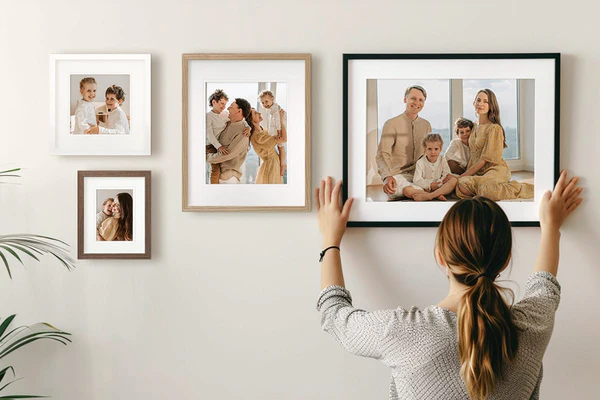
Walls are among the most overlooked communication tools in any home. Long before a guest sits down, before a conversation starts, the surfaces surrounding them have already delivered a message. Whether intentional or not, how a space is arranged — and what goes on its walls — shapes how people feel about the moment they walk in.
This is not a matter of taste alone. Psychology researchers studying environmental cues have consistently found that visual stimuli in a room influence mood, perceived warmth, and even how comfortable someone feels staying in a space. A well-arranged wall signal of care and intention. A bare or cluttered wall signals something else entirely.
The Psychology of Arranged Spaces
Interior environments affect behavior in measurable ways. Studies in environmental psychology point to the concept of “place attachment” — the emotional bond people form with spaces that feel personal and curated. Rooms with meaningful objects, deliberate layout, and visual cohesion tend to produce a stronger sense of belonging for both residents and visitors.
This is why what gets hung on a wall, and how, carries more weight than most homeowners assume. A collection of framed photographs arranged thoughtfully along a hallway does more than fill empty space — it tells a story. It communicates history, personality, and stability.
Why Arrangement Matters as Much as Selection
Choosing what to display is only half the equation. The arrangement — spacing, alignment, height, and grouping — determines whether a wall reads as intentional or accidental. Gallery walls that feel curated follow consistent logic: similar frame widths, coordinated color tones, or a shared visual theme. Without structure, even beautiful individual pieces can feel chaotic together.
This is where the mechanics of hanging come in. Consistent spacing between frames, level alignment, and secure mounting are the foundation of a finished look. Many people underestimate how much uneven spacing or slightly tilted frames undercut an otherwise well-chosen display. Using picture hanging kits that include the right hardware for different wall types and frame weights takes the guesswork out of execution, allowing the arrangement to look as considered as it was intended to be.
Walls as a Reflection of Priorities
Beyond aesthetics, wall displays communicate values. Homes where children’s artwork is prominently framed — rather than stuck to a refrigerator — signal that creative expression is celebrated. Homes with travel photographs on display hint at curiosity and experience.
Walls that feature only mass-produced prints without any personal element tend to feel transactional, like a hotel lobby rather than a lived-in home.
None of these requires significant investment. A deliberate approach to what gets displayed, and how it is arranged, has far more impact than expensive artwork alone. A single framed print placed at the correct height on an otherwise empty wall often reads better than five pieces hung carelessly.
The Functional Side of Wall Display
Walls in a home also carry practical roles beyond decoration. Entryway hooks, shelving systems, and framed mirrors all serve functional purposes while contributing to the overall visual impression. In smaller homes, vertical surfaces are among the few remaining areas that can be organized without consuming floor space.
When wall systems are thoughtfully integrated — storage that doubles as visual interest, mirrors that expand perceived space, art that reinforces a room’s color palette — the result is a home that feels cohesive rather than compartmentalized.
Getting the Details Right
The details that most people dismiss are often what separate a space that feels finished from one that does not. This includes the height at which art is hung (eye level, typically around 57 to 60 inches from the floor to the center of the piece, is the gallery standard), the relationship between frame size and wall scale, and the weight distribution across a wall surface.
Walls with a single small frame in the center of a large expanse tend to feel timid. Walls that are overfilled lose visual breathing room. The ideal falls somewhere between — enough to hold attention, deliberate enough to reward it.
Creating a Space Worth Walking Into
The walls of a home are among the most permanent-seeming and least frequently reconsidered surfaces in daily life. Furniture gets rearranged. Floors get new rugs. But walls often stay exactly as they were set up on move-in day or accumulate pieces over time without a governing plan.
Taking a more intentional approach — deciding what a wall should communicate, choosing pieces that serve that purpose, and executing the arrangement with care —
transforms a passive background into an active part of how a home feels. That impression, formed within seconds of entering a room, is one of the most lasting ones a space creates.