
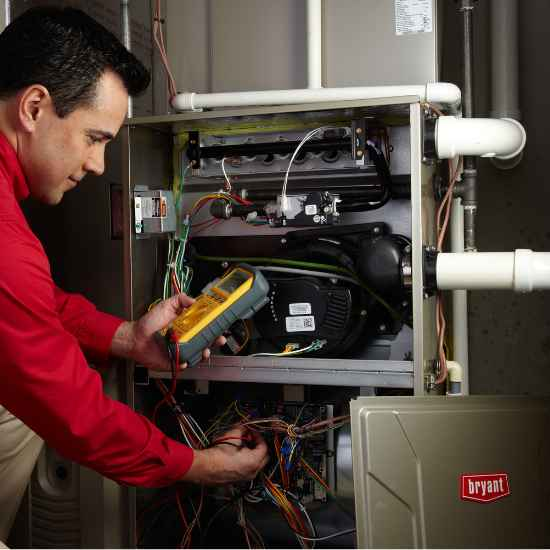
Coldest night of the year, and the house won’t warm up. The mind jumps straight to the worst number: what does a new furnace cost? Slow down. A furnace not heating is very often something small, and plenty of no-heat calls in the Ottawa Valley get sorted in ten minutes with no parts at all. A filter nobody swapped. A popped breaker. A vent buried in snow. Work the list from the top. Easy stuff first, serious stuff last, and one rule throughout: when gas or fire enters the picture, you stop and call licensed professionals of RB Heating Climatecare.
1. Make Sure Your Thermostat Is Set Correctly
Confirm the thermostat is set to HEAT, not COOL or OFF, and push the setpoint 5 degrees above the room’s current reading. Some units won’t fire without a real demand. Check the fan setting as well. Left on ON instead of AUTO, the blower runs nonstop, pushing cool air around, which feels exactly like a broken furnace but isn’t.
Battery-powered thermostat? Swap the batteries. That fix alone closes out more service calls than anyone in the trade cares to admit. On smart models, check the schedule too, since it can quietly slip after a firmware update and drop the house into an away setting you never chose.
2. Check the Furnace Power Supply
Gas furnaces still need electricity. The board, blower, and ignition all die without it, so a home heating problem is sometimes an electrical one.
Check the Circuit Breaker
A tripped furnace breaker sometimes sits dead centre rather than fully off, easy to miss on a quick scan. Push it hard to OFF, then back to ON. If it trips again right away, phone a technician. A breaker that keeps letting go is telling you about a short or a failing motor, and resetting it repeatedly is a fire risk, not a fix.
Confirm the Furnace Power Switch Is On
There’s a switch on or beside the furnace that looks like an ordinary light switch. Anyone hauling boxes past it in the basement flips it by accident. Make sure it’s ON. Check that the access panel is latched shut, too. A safety interlock holds that door closed, and if it sits even slightly ajar, the furnace refuses to run.
3. Replace a Dirty Air Filter
When a filter plugs up, air stops moving across the heat exchanger, heat backs up in the cabinet, and the high limit switch kills the burners to stop things from cooking.
Pull the filter and hold it up to a light. If you can’t see the bulb through it, replace it. Check every month during heating season, more often with pets or renovation dust in the house.
4. Confirm the Gas Supply Is Turned On
Trace the gas line to the furnace and look at the shutoff valve. Handling in parallel with the pipe means gas is flowing. Crosswise means shut. Somebody may have closed it during a repair and forgotten to reopen it. Then check your other gas appliances.
5. Inspect the Pilot Light or Electronic Ignition
Furnaces built before roughly 2010 usually carry a standing pilot light. Look through the small window near the burners. A healthy pilot burns steadily and blue. Yellow or orange means incomplete combustion, and that’s a call, not a DIY. If the pilot is simply out, relighting instructions are printed on a label on the cabinet. Follow them exactly, and if you smell gas at any point, stop.
Newer furnaces use an electronic igniter with a flame sensor, a thin metal rod sitting in the burner flame. Over time, it films over with soot until it can’t confirm a flame is there, so the furnace shuts the gas off within seconds, every time. A filthy $15 part, causing a no-heat call. Cleaning it is routine on any tune-up.
6. Look for Furnace Error Codes
Modern furnaces tell you what’s wrong. Behind the access panel, a small LED on the control board blinks a pattern: three flashes, a pause, three again. Count them. The legend decoding them is printed inside the furnace door.
What Do Furnace Error Codes Mean?
Codes vary by brand, but the faults repeat across every make. The ones you’ll meet:
- Open limit/overheating. Nearly always restricted airflow. Change the filter, open the vents.
- Pressure switch fault. Points to a venting problem, a blocked exhaust, or a clogged condensate drain.
- Ignition lockout. The furnace tried, failed several times, and locked itself out. Many boards enforce a one-hour wait before retrying.
- Flame sensor fault. Lit, then lost the flame signal. Usually a dirty sensor rod.
- Rollout switch open. Flame escaped the burner area. Shut the furnace off and call immediately. This one is never DIY.
Worth knowing: the code tells you where the sequence failed, not always which part died. A pressure switch code often traces back to a dirty filter.
7. Check Supply and Return Air Vents
Every supply register should be open, none hidden behind a couch or a stack of laundry. People close vents in spare rooms, believing it saves money. It doesn’t. It raises duct pressure, chokes airflow, and can trip the same limit switch that shuts the burners down. Return vents matter just as much. Those are the larger grilles pulling air back to the furnace, and blocking them starves the system.
8. Inspect Outdoor Intake and Exhaust Pipes
High-efficiency furnaces vent through two white PVC pipes exiting an exterior wall. Snow drifts. Ice builds. A plow berm buries them. Blocked pipes trip the pressure switch, and the furnace shuts down deliberately, because it can’t safely push exhaust out. After heavy snow, clear a wide space around both pipes, and check for ice at the openings or a nest a bird built there in the fall.
9. Listen for Unusual Sounds and Smells
Your furnace talks. Learning the vocabulary saves money.
Common Furnace Noises and Their Causes
Squealing usually points to a blower belt or motor bearing. Grinding is metal on metal, so shut it down now. Rattling can be a loose panel, nothing more. Booming, or a delayed whump on startup, is the serious one. That’s gas pooling before ignition, and it needs a technician.
Which Furnace Smells Are Dangerous?
A dusty, burnt smell on the first fire of the season is normal and clears within an hour. That’s the odourant added to natural gas, and it means a leak. Leave the house with everyone in it and call the gas utility from outside. Don’t flip switches on your way out. Carbon monoxide has no smell at all, which is precisely why it kills. Headaches, dizziness, or nausea that ease once you step outside,e point straight at CO. Get out, call for help.
10. Check for Airflow Problems
Warm air, but weak? Feel the air at a register. Warm but barely moving points to the filter first, then the blower. A blower wheel caked in dust moves a fraction of the air it should. Leaky or disconnected basement ductwork can also be dumping your heat into the joists.
11. Reset the Furnace Safely
Sometimes the board wants a reboot. Flip the furnace power switch OFF, wait thirty seconds, flip it back ON. Give it a few minutes to run its sequence: inducer, ignition, flame, blower. One rule, though. Reset once.
12. Know Which Problems You Should Never Fix Yourself
In Ontario, gas work is legally restricted to TSSA-licensed technicians. The failure modes here are fire and carbon monoxide. Never touch the gas valve, heat exchanger, burners, or control board wiring. And never bypass a safety switch, whatever a video online tells you. Those switches exist to save your life. If you need professional assistance, contact a trusted provider of home heating services.
Signs You Need Immediate Professional Help
- You smell gas or the rotten egg odour anywhere in the home
- The CO alarm sounds, or if anyone feels dizzy, foggy, or nauseous
- The burner flame burns yellow instead of blue
- A rollout switch has tripped
- You see soot, scorch marks, or rust around the burners
- The breaker trips repeatedly
Any one of these means power off and out of the house if gas or CO is involved.
13. When to Call a Professional for Furnace Repair
Worked the whole list, and it still won’t heat? Or the code keeps returning? That’s your signal. A licensed tech carries tools that actually diagnose: a manometer for pressure, a meter reading flame current in microamps, and a combustion analyzer. Guessing at parts gets expensive fast. Weighing repair against replacement comes down to age. Most furnaces give 15 to 20 years. Past that and facing a major repair, put the money toward an energy-efficient furnace installation instead and see which rebates you qualify for. Anything younger, book a professional furnace repair and have it diagnosed properly.
14. Prevent Future Breakdowns with Annual Furnace Maintenance
A fall tune-up cleans the flame sensor, inspects the heat exchanger for cracks, tests the safety switches, and finds the worn capacitor before January finds it for you. It also keeps your manufacturer’s warranty intact, since most brands want proof of yearly service before honouring a claim. Booking annual furnace maintenance each fall is the cheapest heating insurance going. A tune-up costs a fraction of one emergency call at 3 a.m. on a holiday weekend.
Conclusion
Gas smells, CO alarms, yellow flames, and tripped rollout switches aren’t troubleshooting steps; they’re emergencies. Shut it down and get help. When furnace troubleshooting hits the end of what’s safe to do yourself, our licensed team handles it from there, and a bit of furnace maintenance each fall means you probably won’t be calling us at midnight.